Thursday, June 10, 2010

Talk about Family Planning

I was really glad to see both mamas and papas at my talks. I think in the past many men felt birth control was just a women’s thing, but I am glad they understand it should be a decision together. And the men also got to hear the facts about dangerous pregnancies and gave them a lot to think about in terms of family responsibility. And I was happy that some youth came that should be aware of their options. Of course I hope that parents will take my lessons I teach and talk about them with their kids but some things may be a little uncomfortable for them. My host papa was a big supporter – lecturing the men that it’s not easy for the women to give birth and that he has witnessed the pain and joy of all 3 of his son’s births. He also told them that he has realized that the day to day responsibilities of looking after the kids usually lands primarily on the women and therefore too many kids can be overwhelming for a mother. Which is so true these moms are up when the roosters crow in the morning till everyone is asleep – cooking over a fire, gathering food from the garden, hand washing all the clothes etc etc.

I am just so amazed by my host papa he is such a forward thinker.

Thursday, June 3, 2010

Talk about HIV/AIDS

This week my health talk topic was on HIV/AIDS. For many of the papas and mamas this was the first time hearing about this disease. As I mentioned before HIV/AIDS has barely touched Vanuatu and very little has been done in the past to educate the people especially those on the small rural islands, but that is beginning to change now through radio broadcasts and more training of Village Health Workers to spread the word.

The parents all seemed appreciative to have someone care to give them the facts and they all were enthusiastic to take the information back to their homes. Many of the older parents see how life has changed in Vanuatu and not necessarily for the good. And although Port Vila (the capital) represents a lot of opportunity for education and income they also see it as a place of temptation and sinners. I understand their apprehension sending their kids there but as I’m sure every parent no matter what country feels some sense of fright and hope that their kids will make good decisions – that they taught them well.

Monday, May 24, 2010

Bring her Dad to Tongariki

On Friday, we made it safely to Tongoa – the plane was very small just 6 passengers. And the boat ride over to Tongariki was a lil bumpy but no one got sick just a lil wet.

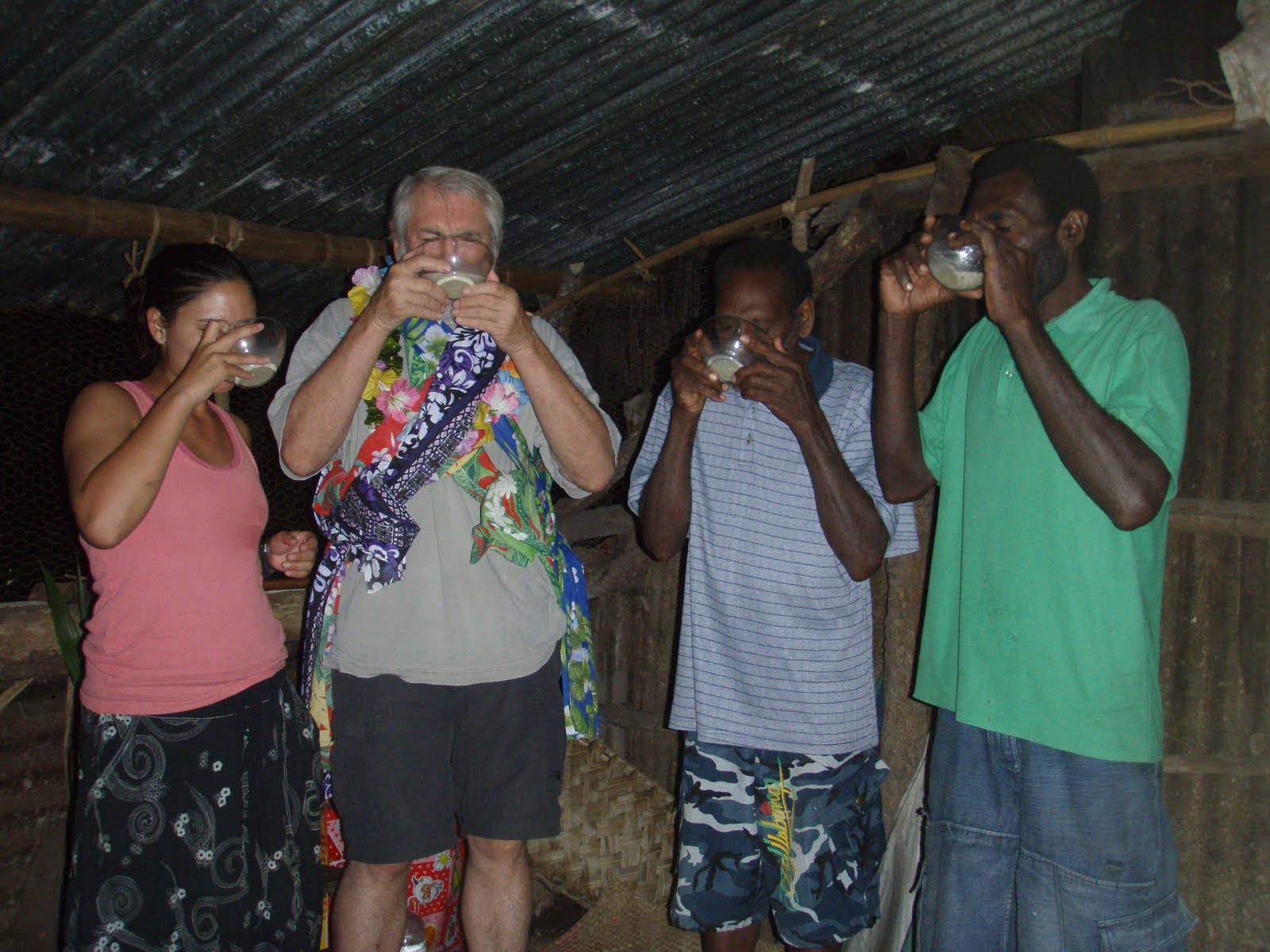
That night the Health Committee got together to welcome my dad and exchange gifts. He also tasted the kava (Tongariki style) and definitely felt more effects then when he tried it in Ambae.


Saturday and Sunday it rained and rained so we were stuck in my hut reading and playing gin rummy. Monday the weather was better and my dad was able to fly back to Vila to catch his flight home.

I think my dad really got a true taste of Vanuatu and the experience of a volunteer:
- we went to 5 islands
- he met a lot of the volunteers in Vila
- we had plane delays and cancellations
- tons of rain
- hiked a volcano and got a tattoo
- ate lap lap
And so much more

Although I’m sure my dad appreciated getting a first hand account – I think he was glad to be going back to the comforts of home after 2 weeks of “aelan laef”.

Tuesday, May 18, 2010

On the Road to Manaro


On Ambae there is a volcano named Manaro that is not easily hiked, somewhat picturesque and has a few custom stories behind it. One story is that a small man used to dwell in the volcano and he was the volcano’s source of power but then the American came over and stole the man away for his strength and power and that is why America is a super power and why the volcano hasn’t erupted again. Another story is that there is a custom tattoo of 2 parallel lines representing the road to Manaro and those that possess this tattoo will be permitted in the after life to return to the volcano and dance on the top. When I heard this story I thought we gotta hike this and get the tattoo which many past volunteers have done before.

My dad the avid hiker agreed to come along as well as Ed and Beth. We drove out to the South side of the volcano and started from xx village. There we were greeted with flowers, coconut water and a welcome ceremony from the chief. We set off about 930am with a large group of locals and trudged our way up to the top. The view was non-existent since too much fog and clouds but it at least the temperature was cool. The Hike was strenuous and seemed to take forever, the guide kept telling us “just 10 more minutes” which really meant “another hour”. Finally we made it to the top and could look out to the lake and see steam rising. It was nice although no as spectacular as the view from a plane up above or to seeing an active volcano like on Tanna. So some may ask why get the tattoo since who would want to dance for eternity on a so-so looking volcano. But it felt like a rite of passage to make it to the top where so many other PC vols journeyed and with similar stories of struggling up and having a sense of accomplishment once completed. It’s kinda like a PC volunteer’s service. We all made it down by sunset and enjoyed some island food and kava at the village. They even performed some custom dances for us that were so neat to watch (not at all touristy but genuine). Now as I mentioned it is tradition that vols not only hike Manaro but as well get the custom tattoo. I somehow convinced my dad that he and I should get the tattoo. I’d actually convinced him months ago because I really wanted to share the experience with him. To me the tattoo wasn’t just about the hand stamp to some party on a volcano in the afterlife it represented to me the PC journey and Vanuatu. And it wouldn’t be me dancing for eternity but hiking with my dad forever. The tattoos were done by Bob who has done 24 PC vols before us. He used a orange tree needle and kerosene soot and ashes as the ink and dapped medicinal custom leaves to the area. My dad got his on his right calf on the outside and I got my on the inside of my right wrist. The lines are not exactly straight and precise but that what the road is like. The pain was bearable once the area went numb (haha). As we were getting the tattoos the villagers all crowded around to watch – Dad said we were their entertainment for the night. Around 8pm we finally made it back to Ed and Beth’s house and everyone was tired and sore. It was a quick bucket shower and straight to bed for us all.

Sunday, May 16, 2010

In Espiritu Santo


My dad arrived on May 8th after a long delay in Fiji, however I am so glad he made it. His first few days unfortunately had to be spent in Vila on his own since I had a PC In-Service Training to attend. So, while I was listening to quest speakers from various aid organizations and departments in the Ministry of Health my dad was wondering the streets (really though Port Vila is really small – only 2 main streets). But once my training was over we headed off to Espiritu Santo – a large Island North of Port Vila, Efate. We stayed in Lunganville where the US had a large military base during WWII. Santo is known for their diving, however neither my dad nor I are certified. Instead we hiked through the jungle to Millennium Cave. The cave got its name because it just opened in 2000, before locals believed it was taboo to go inside since evil spirits lurk in caves. Well no evil spirits just lots of water and some kind of crawfish. In order to get to the cave we walked about 2 hours in the bush, over bamboo bridges and down ladders to the mouth of the cave. Once inside it’s almost an hour walk though knee to waist deep water. The cave is huge and when you look up you can barely make out the roof and you can see bats fluttering around. The walls are smooth but carved in waves. It was definitely a site to see unfortunately the water was fairly strong and I was more worried about getting carried away then enjoying the scenery. Once out of the cave the river winds back towards the start of the trail. We were supposed to ride inner-tubes down the river but since the current was too strong we had to hike back around the cave. The weather held up just until we reached half way back to the care and then buckets of water rained down on us. Around 6 pm we got back to the hotel soaking wet, cold and completely exhausted.

Friday, May 7, 2010

Attend a Weeklong HIV/AIDS Workshop


Today was the last day of the workshop. There were about 50 participants both Village Health Workers (VHWs) and PC health volunteers. The beginning of the week we focused on the facts and the last half focused on how to take the information and share it with communities. Vanuatu only has 5 reported cases of HIV/AIDS, however I am certain that the number is actually a lot more. Not nearly enough of the population has been tested due to accessibility and lack of education. All of the VHWs seemed to have learned a lot and are excited to get back to their communities. For some this was their first trip to Port Vila. It was also interesting to witness some good debates on the practice on encouraging condom usage amongst the unmarried youth. One individual felt very strongly that condoms were like a passport for wreck-less behavior having multiple partners and such. Another, a Pastor, defended condoms stating that the reality is kids will be kids and some will “wokabaot long road” no matter what and so it’s better to arm them with protection. I wonder what kind of reaction I’ll get from the mamas and papas on Tongariki when I talk to them in a few weeks???


Thursday, April 8, 2010

Tokabaot the helt program on Tongariki

Today we had another Health Committee meeting to focus on the final details of the Helt Program (health program) that the committee and I have created.

From the household surveys that I did with every family there was an overwhelming number (almost 100%) that expressed they needed an alternative to the costly kerosene lantern. As well many other issues became apparent from doing the survey such as a lack of health education with the adults.

I knew of an alternative solar powered lantern (D.Light) that sells in Vila for about $60, but I didn’t know how to incorporate everything into a project.

But with some encouragement and help from family and friends the “Give Light & Help Make a Brighter Future” Health Program came about.

The health survey of 47 households gave me and the health committee a lot of valuable information to help design a program that addresses some of the lack of knowledge and good health practices of the people.

The following are some of the statistical results from the survey: Hand washing is not a high priority as most reported that they occasionally will wash before cooking or eating. 66 % throw their trash in the bushes and burn it. Only 16% of young girls and women use some form of family planning and 57% could not name one sexually transmitted infection. 42% think that people get sick because of black magic.

At present there are only four homes that use solar lighting and the rest rely on kerosene lanterns and battery operated flashlights. One family will typically use 2 bottles (about a total of 24 ounces) a week at a total cost of 200 vt ($2) and 10,400 vt ($104) for the year. Batteries are costly as well at 100 vt ($1) per battery. Another disadvantage is due to the limited shipments arriving to the island there are frequent shortages of kerosene and batteries and families must resort back to making candles with coconut oil or be in bed by 7pm.

There are few paying jobs available on the island and all 10 positions are provided through the health facility and school. Most families depend on selling crops, mats and small animals on Tongariki and in the capital city (for example a chicken fetches 500 vt ($5) or a mat will fetch 500-1,000 vt ($5-10) for 1-2 days of weaving). Many families find it difficult to provide even the basic necessities such as clothes and school fees for their family.

The Health Program won’t just give solar lanterns to the 73 families on Tongariki but each family will participate in a program in increase their knowledge and encourage better health practices. The adults in each family will attend 6 health talks that I will give with the aid of Shelly and Pastor Rueban on: hygiene, common illnesses, first aid, HIV/AIDS + STIs, family planning and non-communicable diseases. Also, each household will need to have a trash pit for all non-degradable items and a place to wash your hands outside of their toilet.