Thursday, November 12, 2009

Describe Her New Home

This is the front of my hut
My compound is a nice sized property complete with a one bedroom house with a entry room/office/pantry, a separate kitchen hut and an outhouse/shower hut. And I’ve got a yard :)

The huts are custom design with wild cane (thin bamboo like sticks) woven walls and the roof is panels of coconut leaves and wild cane. The floor is black coral with pandana leaf woven mats laid on top.

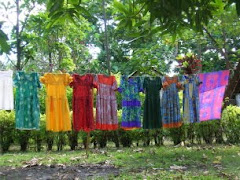
To give the place some color and to shield me from creepy crawlers I’ve hung yards and yards of different patterns (lots of island print) and colors of fabric (or ‘calico’ as all the Ni-Vans say). Anywhere else it would be extremely tacky but each piece of calico was tied around me like a sash given as a gift when I arrived and now it decorates my walls and ceiling – it’s a nice reminder of my welcome to the island. And all the kids think it looks “tuf” (pronounced ‘daaff’ = means ‘cool’).

the front room my bedroom


In my kitchen, I’m using only fire to cook just like all the other islanders. However, it usually takes me multiple attempts, lots of matches wasted and tons of smoke before I get a roaring fire going. It doesn’t help too that I always have an audience of kids watching, but I have a lot more respect for the woman of Vanuatu – cooking is hard work here – even a simple dish.


this pic is taken from my front door looking at my kitchen


The bathroom. The toilet is a water seal toilet meaning it’s a cement version of a real American toilet without the flush. I have to manually pour down some water to make it “flush”. Pretty posh for a hut? (sorry for the details of a toilet but I figure you might be curious) The shower room has a tree stump stool and small shelf to make taking bucket showers all that more easy and comfortable.


my yard & in the distance is my bathroom hut

Wednesday, November 11, 2009

Unpack

Inside my hut before I unpacked and decorated

I had a week in Port Vila (the capital) to buy all my groceries and supplies to set up house on Tongariki. However, without ever visiting the place you can never remember or even think of everything you will need or the opposite that you end up with a ton of crap. I tried not to think too much about cost and focus more on what will make me comfortable and happy – as was suggested by all the current volunteers.

And so I ended up with 6 bags, which they all arrived on the ship (Saratoko) and I spent the rest of the day unpacking and putting those little personal touches around the hut.


Tuesday, November 10, 2009

Arrive on Tongariki

my bags are packed and waiting for my ride to Tongariki

the shore of Tongariki


Well it was more like land on Tongoa (flight time 30min) and take a boat (for 1 hr) over to Tongariki and then hike up (35min) to my new home in Erata village on Tongariki.

They had a welcome ceremony once I came on top – the shell horn blew and I was escorted with a singing and dancing procession of villagers to the front door of my new home. When I first saw what I would be calling “home sweet home” for the next 2 years I instantly gave a sigh of relief and tears started to well up because it was an adorable hut and I could tell how hard they worked on it.

I stood in front of the house for a bit while everyone gathered outside around me and the chief gave me my new custom name – Lei Riki (which ‘Lei’ means ‘woman’ and ‘Riki’ is for ‘Tongariki’, so woman of Tongariki).

Next we all walked over to the nakamal (central meeting place in a village) where welcome speeches were given and then I got up and in my best Bislama I could muster how grateful I was to be there and gave a short bio about myself. Everyone was all smiles towards me so I think their first impression of their new volunteer was a good one – at least I hope so.

Before we all ate lunch there was a kava ceremony.
*Side Note: in Vanuatu there are many different ways to prepare kava (piper methysticum – a mildly narcotic drink made by squeezing liquid from the roots of the plant). In the capital they will use a meat grinder, on Maewo they use stones to grind the roots and on Tongariki they chew the roots first and then squeeze out the liquid. I’ve tasted all of these different ways and kava on Tongariki is strong – mi harem I kik!

After the feast and chatting with my new neighbors I was exhausted and relieved.


Sunday, November 8, 2009

Get on a plane then a boat & finally arrive home

I am heading off to Tongariki this afternoon and I'm nervous and excited. I hope they like me.

I'll be on the island for the holiday season so I wish you all a Happy Thanksgiving, a Merry Christmas and a Happy New Year!!!!

Hopefully you all got a chance to check out my adventures in training - I wrote the posts in the village and just back dated them all once I had internet access - so you may want to start from the begining and work your way forward.

Also, I wont have internet until I come back into the capital (Port Vila on Efate) in January so this will be my last post for awhile but look for updates mid Jan.

Miss you all and please write letters if you can :)

Friday, October 30, 2009

Prepare to move into her new home (hut that is)

Niki in Tongariki. That’s what I like to tell people because its fun to say and it rhymes.

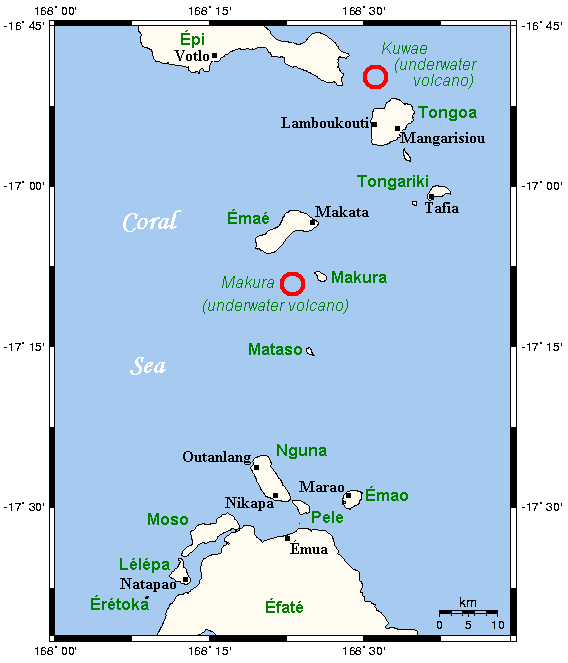
Today I found out that my new home for the next 2 years will be in a village called Erate on Tongariki. Now it’s a very very small island (2km by 4km) – so small it may not even be on your map but its just below Epi and Tongoa. There are 4 other villages on this island (Lawaima, Mu-ur, Tavia, and Lakilia) and only 350 people total on the whole island. In order to get there you can either take a ship from Port Vila (which could take 18-24 hours) or fly to Tongoa and then a quick (~1.5 hr depending on the ocean) to Tongariki. Once you get to the shore I hear it’s a steep but short climb to the village. We will see how I react after I go for the first time if this island is easy to get to or not. There are no banks or post offices on the island so I’ll have to go to Tongoa every other month or so because really how much money do you need on an island? But I’ll likely head over there anyways just to go and socialize with another volunteer as on Tongariki it’s “mi wan nomo” – I’m it for the island the closest volunteers are on Tongoa. But its all good – just think I’ll helping an entire island.

If you want to read about the previous volunteer, Sarah Sherry, that I’ll be replacing you can check out an article she wrote – she’s a much better writer then I am and she gives a good description of the island and the work I’ll be doing.
http://www.peacecorps.vu/experiences/FromAlaskaToSouthPacific.html

Sunday, October 4, 2009

Go Visit Nguna

Well I needed a break from training and when the opportunity came up to go and visit the surrounding Aid Posts/Dispensaries/Health Clinic. I thought I'd be clever and choose to visit the Dispensary on Nguna a small island just off of Efate (you can see it from P-town) - so I got to get out of town and complete an assignment :) A few of us went together on the 45 minute boat ride and 45 minute walk up to the village to visit Leiwaku - the nurse that works at the Dispensary. I think it renewed all our spirits to see another village and to practice our Bislama skills - it got us all excited for our future sites (and it seems as Leiwaku let it slip that one of the health volunteers will be calling Nguna there home very soon).

So, as a little background on the interworking of the health care system in Vanuatu let me try to briefly describe how it works (keep in mind I still am learning too)… Each village (in a perfect world) will have a health committee that designates one person in the community to be trained (10 wk program) as a Village Health Worker (VHW) and then run the Aid Post in the community. Now the VHW can do basic first aid and can give medication for common ailments - however it isn't stocked with drugs and if there is a serious problem the patient must be referred. There are problems that arise in this situation as some villages don't have a properly functioning health committee and therefore don't have a aid post or they may have a VHW but they cant continue to work and support their family (they may not have enough money or can't get to the garden to get food - that's also why the health committee is so important as a village they need to support the VHW). The next step on the health care chain is the Dispensary, which is supposed to have a nurse and possible a nurse aide as well (however in many cases it’s just one of the two) and the facility can do first aid, treat ailments, deliver babies and is stocked with medications. The next step on the referral system – since at the dispensary they can not necessarily diagnose everything and a patient may need to go to the hospital or if the problem is too big they will go to the nearest hospital. But we are on islands here and due to weather and distance trying to get to a hospital can be a difficult task.


On the boat ride to Nguna - next to me are my Aunt (smol mama) and my cousin

All of us on the Nguna's shore

Thursday, October 1, 2009

Become a Domestic Goddess

Just a few weeks here in Vanuatu and already I'm learning how to cook by fire - I've been learning how to make traditional island food like laplap (which is a pudding consistensy that is baked) and simboro (which is a starch like manioc or yams that are wrapped in island cabbage). I have also made a banana cake and pancakes so I will be able enjoy some comfort foods from home and I have even made my own banana jam.

I also have learned how to weave using pandana leaves - I can make bracelets, rings and mats (they are still very small more like a place mat - it just hurts my back too much to be hunched over - I dont know how the Ni-Van mama's do it).


I'll definately fetch a nice bride price with all my new skills I'm learning :) haha